


When your child is getting ready to enter school, it’s natural to wonder if they’re prepared for the social and learning expectations of the classroom.
For a child with autism, school readiness isn’t just about knowing letters and numbers. It’s also about developing the foundational skills that help them thrive in a group setting.
How do you know if your child with autism will find success at school? We asked Jamie McGillivary, BCBA, President and Founder of Healing Haven, a metro Detroit ABA therapy center for children and teens.
“For a child with autism, being placed in a mainstream environment like school doesn’t ensure they will pick up the skill sets they need. Some people do believe that if they can just get the child into a classroom, they’ll be fine. But that’s like putting a child into a calculus class before they’ve learned to add two plus two,” McGillivary says.
What does school readiness look like for a child with autism?
Often, what helps your child with autism thrive at school isn’t what’s taught directly in the classroom. It’s the small, everyday skills they bring with them.
With gaps in communication, behavior, or social interaction, school can become challenging. These skills don’t always come naturally and may need to be taught and practiced intentionally.
Intensive, one-on-one ABA support can help children build these readiness skills, especially those experiencing disruptive behaviors or delays. “Then school is a wonderful place to practice those skills,” McGillivary adds.
What you can do:
- Notice how your child handles group settings like playdates or story time.
- Talk with a BCBA about what school readiness might look like for your child.
How ABA therapy helps prepare your child for the classroom
In school, the focus is on academics. In ABA therapy, it’s on the behaviors that support learning.
“In ABA therapy, children don’t learn to read or do math. Instead, they build the skills that can help them learn in a classroom setting,” like learning how to follow instructions, explains McGillivary.
“This skill alone in isolation is difficult for our kids. Following directions in the context of a group is a higher level skill,” she says. “It’s like learning to run before you can walk.”
What you can do:
- Practice simple instructions one-on-one during everyday routines at home.
- Ask your ABA provider which skills your child can start generalizing to group settings.
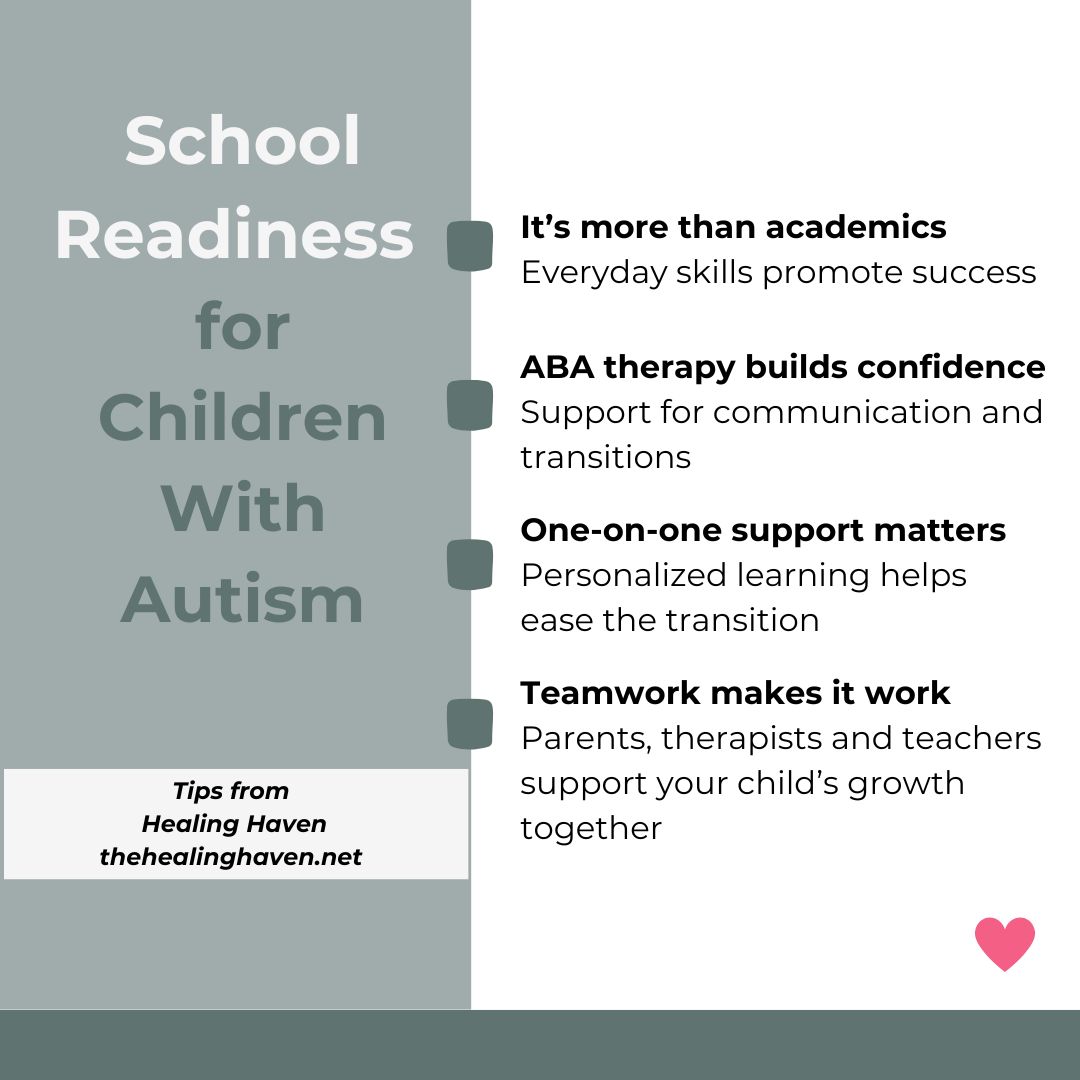
Why one-on-one support may be essential first
Not all students learn at the same pace or in the same way. For some children with autism, a busy classroom isn’t the best place to build early skills.
“For these children, learning opportunities need to take place one-on-one, and schools are often unable to provide intensive learning of this type for students,” McGillivary explains.
When children need to build skills more quickly, ABA therapy offers the chance to focus intensively and add complexity step by step.
“Then we can practice that skill by adding more people slowly and gradually to create a group-like environment. That’s the luxury that we have that schools don’t have,” McGillivary says.
What you can do:
- If your child is struggling in a group, ask if one-on-one support could help.
- Don’t be afraid to pause and build skills in a different setting. Some kids thrive with a mix of school and ABA.
How to collaborate with your child’s school team
As your child transitions to the classroom, strong communication with the school can make all the difference.
“There are so many wonderful teachers who can take what we are doing and carry the baton forward,” says McGillivary. “The best case is when the teacher and parents collaborate together to move forward to the child’s next step of independence.”
Great outcomes happen when professionals combine their expertise with a shared commitment to the child’s success. “No one person is more important than another,” she says. “Parents should look for professionals who understand that and have a desire to work collaboratively.”
What you can do:
- Set regular check-ins with your child’s teacher — just like with your ABA team.
- Build a circle of support that includes educators, therapists and family.
This content is sponsored by Healing Haven, serving metro Detroit families with autism therapy programs at several locations. Discover Healing Haven’s individualized approach for ages 2 to young adult.